How to Memorize Piano Sheet Music Faster
Memorizing piano music is something almost every pianist struggles with at first. As a piano teacher who has worked with beginners for many years, I often see students rely on repeating the same passage again and again, hoping it will eventually stick.
But memorization doesn’t work best through repetition alone.
The secret is learning how the brain remembers music. When you combine pattern recognition, muscle memory, and smart practice methods, memorizing a piano piece becomes much faster and much more reliable.
In this guide, I’ll show you the exact methods I teach my students to help them memorize piano sheet music quickly and confidently.
Contents
- 1 Why Memorizing Piano Music Matters
- 2 Step 1: Understand the Music Before Memorizing
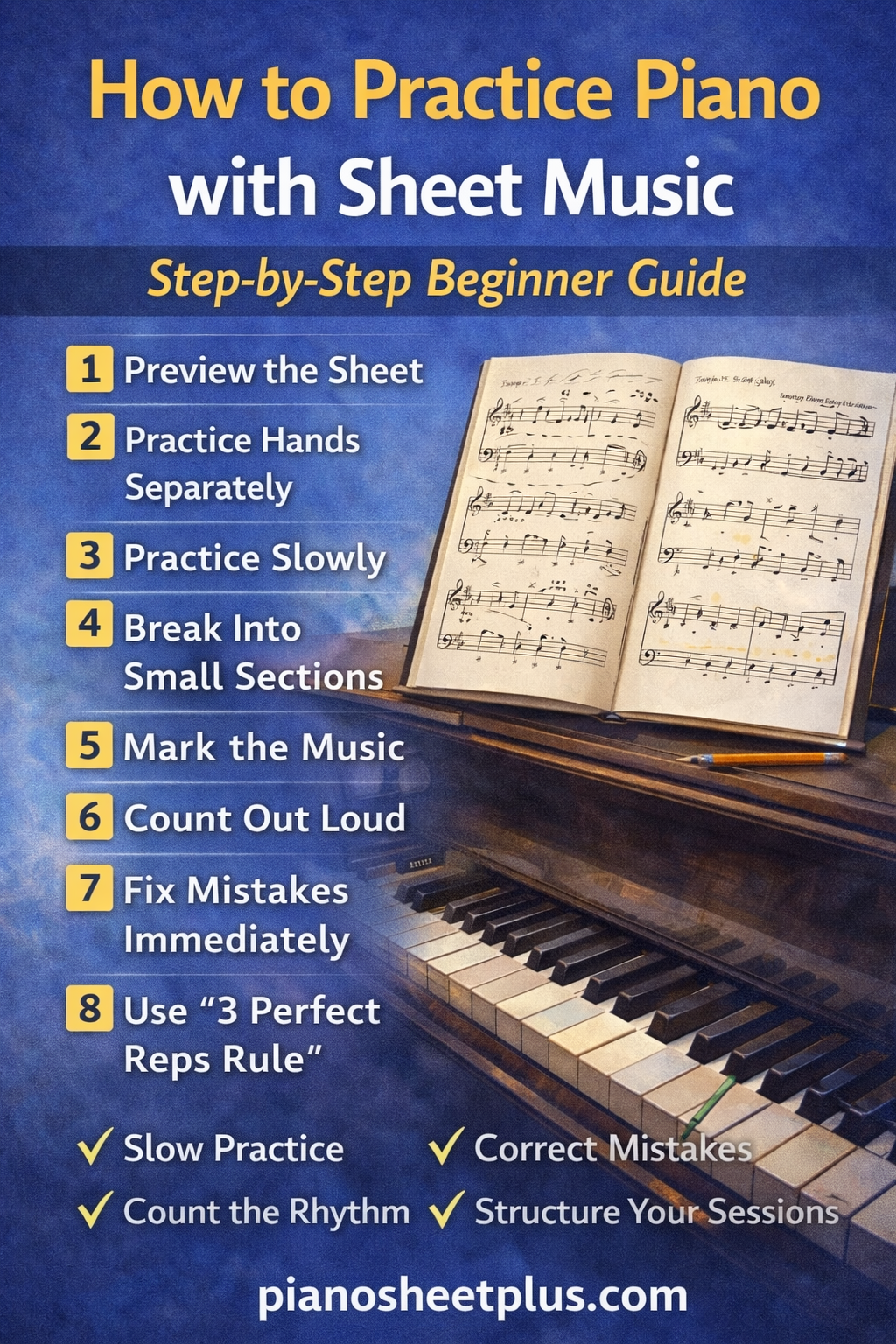
- 3 Step 2: Practice Hands Separately
- 4 Step 3: Break the Music into Small Sections
- 5 Step 4: Practice Slowly with a Metronome
- 6 Step 5: Use Visual Memory
- 7 Step 6: Use the “Three Perfect Repetitions” Rule
- 8 Step 7: Test Your Memory Frequently
- 9 Common Memorization Mistakes
- 10 Simple Weekly Memorization Routine
- 11 FAQ (Rich Result Optimized)
Why Memorizing Piano Music Matters
Memorizing music helps pianists play more freely and musically.
Benefits include:
- stronger musical expression
- fewer performance mistakes
- better understanding of musical structure
- improved confidence when performing
When students stop relying completely on sheet music, they can focus more on phrasing, dynamics, and emotion.
Step 1: Understand the Music Before Memorizing
One of the biggest mistakes beginners make is trying to memorize every individual note.
Instead, start by looking for patterns inside the music.
Common patterns include:
- repeating melodies
- chord progressions
- scale runs
- rhythmic patterns
When students learn to recognize these patterns, the music becomes easier to remember because they are memorizing ideas rather than individual notes.
This is why many teachers recommend starting with easy piano sheet music or beginner piano songs.
Step 2: Practice Hands Separately
Another powerful memorization technique is separate hand practice.
Many students try to learn both hands at the same time, which overloads the brain.
Instead:
- Practice the right hand alone
- Practice the left hand alone
- Slowly combine both hands
Once each hand feels comfortable, your brain already understands most of the music, making memorization much easier.
Step 3: Break the Music into Small Sections
Trying to memorize a full page of sheet music at once is rarely effective.
Professional musicians almost always learn pieces in very small sections.
For beginners, a good section size is:
- 2 measures
- 4 measures
- one musical phrase
Once one section is memorized, move to the next and gradually connect them together.
This approach works especially well when practicing with printable piano sheet music PDF.
Step 4: Practice Slowly with a Metronome
Speed is one of the biggest enemies of memorization.
When students practice too quickly, mistakes appear and the brain cannot form reliable memory.
Instead:
- play slowly
- focus on accuracy
- use a metronome
A good rule is to practice at 50–60% of the final tempo.
Slow practice allows your brain to build clean muscle memory.
Step 5: Use Visual Memory
Many experienced pianists develop visual memory of the sheet music.
That means they can mentally picture the notes even without the sheet in front of them.
You can train this skill by briefly looking at a measure, closing your eyes, and imagining the notes before playing.
Step 6: Use the “Three Perfect Repetitions” Rule
Repetition is important, but only correct repetition builds memory.
A useful technique I teach students is:
Play a section three times perfectly in a row.
If a mistake happens, restart the count.
This ensures that mistakes do not become part of your muscle memory.
Step 7: Test Your Memory Frequently
Once a section feels comfortable, try playing it without looking at the sheet music.
If you forget something:
- glance at the score
- close it again
- try once more
This technique strengthens active recall, which is essential for strong musical memory.
Common Memorization Mistakes
Avoid these common beginner mistakes:
❌ Practicing too fast
❌ Memorizing notes instead of patterns
❌ Practicing large sections
❌ Ignoring rhythm and harmony
Good memorization always comes from smart practice strategies.
Best Music to Practice Memorization
If you want to improve memorization skills, start with pieces that are:
- short
- melodic
- pattern-based
Great practice options include:
- simple classical melodies
- children’s songs
- beginner piano arrangements
These types of music are commonly found in free piano sheet music collections and easy piano sheet music libraries.
Simple Weekly Memorization Routine
Here is a routine I often recommend to beginners.
Day 1
Learn the first 4 measures slowly.
Day 2
Memorize those 4 measures.
Day 3
Add the next 4 measures.
Day 4
Combine both sections.
Day 5
Play the entire piece from memory.
Consistency is far more effective than long practice sessions.
FAQ (Rich Result Optimized)
How long does it take to memorize a piano piece?
Short beginner pieces usually take 3–7 days with regular practice.
Is memorizing piano music necessary?
It is not required, but memorization often improves confidence and musical expression.
What is the fastest way to memorize piano music?
The fastest method combines:
- slow practice
- small sections
- hands separate learning
- repetition with accuracy.
Why do I forget music after memorizing it?
Usually because the music was memorized through repetition alone instead of understanding patterns and structure.
Do professional pianists memorize music?
Yes. Most concert pianists perform from memory, especially in solo performances.