Contents
- 1 How to Practice Piano Using Sheet Music Effectively
- 2 Why Practicing with Sheet Music Matters
- 3 Step 1: Study the Sheet Music Before Playing
- 4 Step 2: Practice Hands Separately
- 5 Step 3: Practice Slowly (Very Slowly)
- 6 Step 4: Use a Metronome
- 7 Step 5: Break the Music Into Small Sections
- 8 Step 6: Repeat Difficult Sections
- 9 Step 7: Read the Music While Playing
- 10 Step 8: Practice Daily (Short Sessions Work Best)
- 11 Helpful Beginner Songs to Practice
- 12 Common Practice Mistakes to Avoid
How to Practice Piano Using Sheet Music Effectively
Learning piano from sheet music is one of the most powerful skills a musician can develop. As a piano teacher with many years of experience teaching beginners, I often see students struggle not because the music is too difficult, but because they don’t yet know how to practice correctly.
Practicing with sheet music is not simply about playing the notes again and again. Effective practice means reading, understanding, and training your hands and brain to work together.
In this guide, I’ll walk you through the exact practice strategies I teach my students so they can learn songs faster, avoid mistakes, and build strong piano skills.
Why Practicing with Sheet Music Matters
Many beginners rely too heavily on tutorials or memorizing notes without reading music. While that can work short-term, it slows long-term progress.
Practicing with sheet music helps you:
- Improve music reading skills
- Develop better rhythm and timing
- Learn new songs faster
- Build musical independence
The more comfortable you become reading sheet music, the easier every new song becomes.
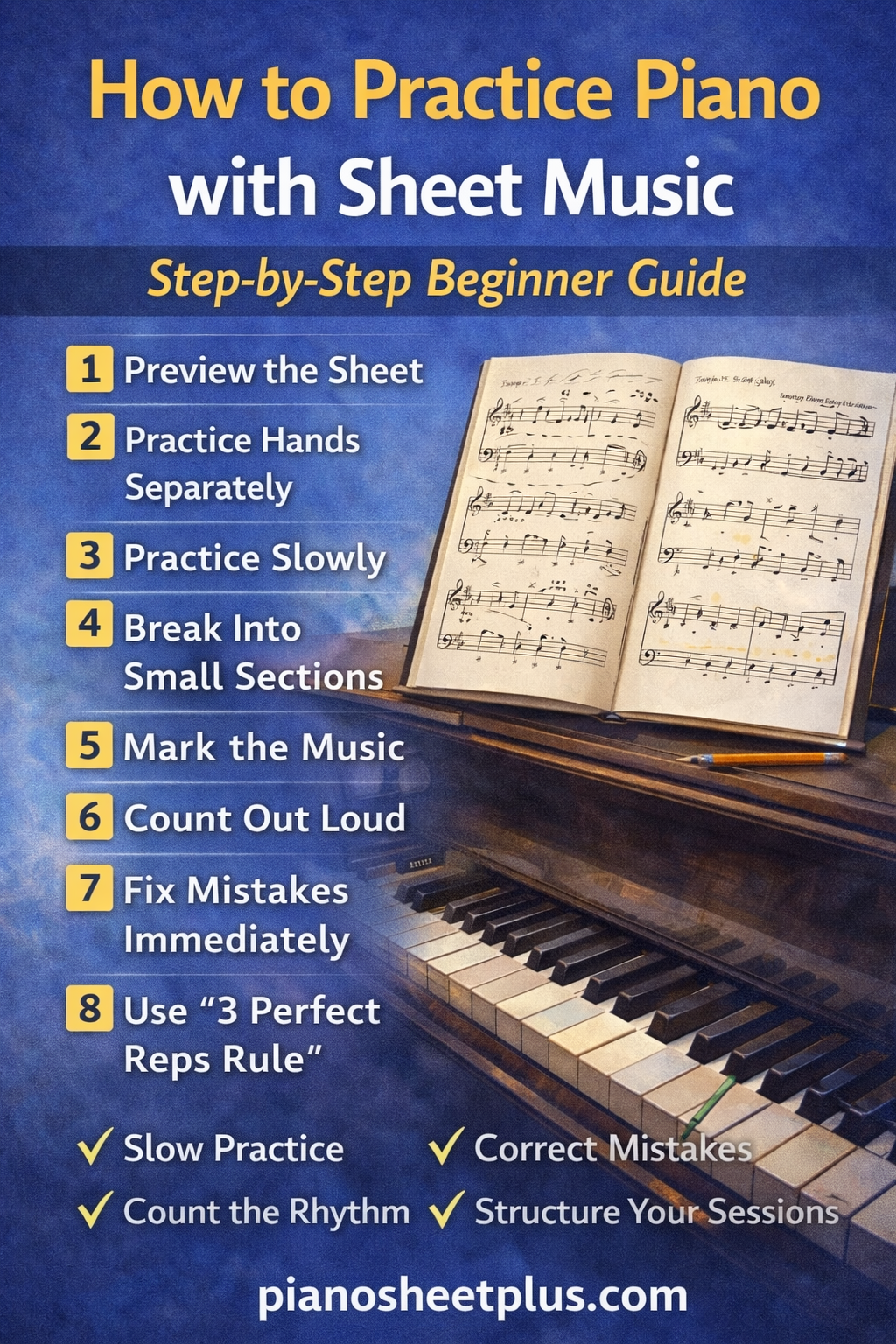
Step 1: Study the Sheet Music Before Playing
Before touching the piano keys, take a moment to analyze the sheet music.
Look for:
- The key signature
- The time signature
- Repeated patterns
- Difficult sections
This short preparation saves a lot of time later.
Professional musicians almost always scan the music first before playing. It prepares your brain for what is coming.
Step 2: Practice Hands Separately
One of the most common beginner mistakes is trying to play both hands immediately.
Instead, start with right hand only, then left hand only.
This helps you:
- Focus on correct notes
- Learn finger movements
- Build coordination gradually
Once each hand feels comfortable, combining them becomes much easier.
Step 3: Practice Slowly (Very Slowly)
Speed is the enemy of accuracy.
If you play too fast while learning, mistakes become habits.
A good rule I teach students:
If you make mistakes, the tempo is too fast.
Use a slow, controlled tempo until every note feels comfortable.
Slow practice builds precision and muscle memory.
Step 4: Use a Metronome
A metronome trains your rhythm and timing.
Start slow, then gradually increase the tempo.
Example practice method:
- Start at 60 BPM
- Play the section correctly
- Increase to 70 BPM
- Continue gradually
This method creates steady improvement without frustration.
Step 5: Break the Music Into Small Sections
Never try to learn an entire song at once.
Instead divide the music into small parts:
- 1 measure
- 2 measures
- 1 musical phrase
Once each small section is comfortable, connect them together.
This technique is used by professional pianists and music teachers worldwide.
Step 6: Repeat Difficult Sections
Every song has challenging spots.
Instead of restarting the entire piece when you make a mistake, isolate the problem area.
Practice it like this:
- Repeat the section 5–10 times slowly
- Focus on finger movement
- Gradually increase speed
Over time the difficult section becomes easy.
Step 7: Read the Music While Playing
A common beginner habit is looking only at the hands.
Try to keep your eyes on the sheet music as much as possible.
This improves:
- Sight reading
- Note recognition
- Musical flow
The goal is to make reading music feel as natural as reading words.
Step 8: Practice Daily (Short Sessions Work Best)
Consistency is more important than long practice sessions.
A simple routine for beginners:
- 15–20 minutes per day
- Warm up
- Practice sections
- Play the full piece slowly
Daily repetition trains your brain and fingers more effectively than occasional long sessions.
Helpful Beginner Songs to Practice
If you’re just starting, these types of pieces are excellent for practicing sheet music skills:
- Easy classical melodies
- Children’s songs
- Simple movie themes
You can also explore:
- Free piano sheet music
- Easy piano songs for beginners
- Printable piano sheet music PDF
These types of pieces are perfect for developing reading ability.
Common Practice Mistakes to Avoid
After years of teaching, these are the mistakes I see most often:
Practicing too fast
Speed causes errors and frustration.
Restarting from the beginning every mistake
Instead, isolate the problem section.
Looking at the hands constantly
Try to train your eyes to stay on the music.
Practicing only once a week
Short daily practice is far more effective.
Avoiding these habits can dramatically speed up your progress.
FAQ (Google Rich Results Optimized)
How long should beginners practice piano with sheet music?
Beginners should practice 15–30 minutes daily. Consistent short sessions are more effective than long occasional practice.
Is it better to memorize piano music or read sheet music?
Both are valuable, but beginners should prioritize reading sheet music first because it builds long-term musical skills.
Why is practicing piano slowly important?
Slow practice allows your brain and fingers to learn the correct movement patterns, reducing mistakes.
Should beginners use a metronome?
Yes. A metronome improves rhythm, timing, and overall musical accuracy.
How long does it take to read piano sheet music fluently?
Most beginners start feeling comfortable after 3–6 months of consistent practice.